
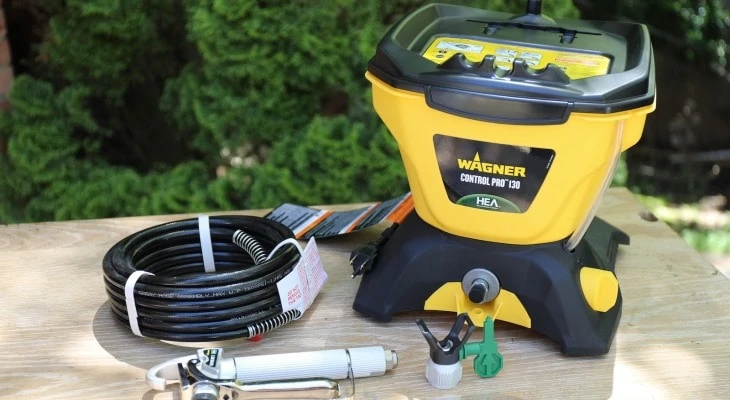
Not caring for and cleaning your Wagner paint sprayer properly can diminish its operational capacity and service life.
You could land up paying more in the long run on repairs or having to buy a whole new sprayer along with its accessories. Follow these necessary cleaning steps on how to care for your paint sprayer for optimum efficiency.
Wagner Paint Sprayers

The Wagner Flexio range is an excellent option for beginners. They are easy to use, and there are a variety of options to choose from:
Cleaning Supplies
Depending on what paint you use, you will need specific cleaning materials.
For latex paint, you should use warm soapy water (dish soap should do the trick). Mineral spirits are the best solution for oil-based paints.
To achieve the most accurate results, you will need the right supplies. These include:
- Warm soapy water or mineral spirits
- An empty 5-gallon bucket
- A soft-bristle cleaning brush
- A dry, clean towel
The process might take a while the first time, but the more you clean your sprayer, the better you will get at it.
Cleaning Your Wagner Paint Sprayer

Once you follow these easy steps, you will have your Wagner Paint Sprayer cleaned in no time.
- Rinse the container and suction tube.
- Spray the cleaning solution.
- Disassemble the Sprayer head and nozzle.
- Scrub, scrub, scrub
- Let it dry
Rinse the Container and Suction Tube
Starting the process is easy. Unplug the Wagner paint sprayer. Empty the suction tube by pulling the trigger for 5-10 seconds, coaxing the paint to fall back into the container. Once the suction tube has been emptied, you can unscrew the container and pour the paint back into its original packaging.
Use the soapy water or mineral spirits to rinse the container and suction tube. Remember to rinse the white container seal located around the suction tube as well.
Always try to clean your paint sprayer immediately after use. It will make cleaning much easier and faster. If you delay the cleaning process, the paint will dry, making cleaning more complex, and you might have to use more potent cleaning materials like paint thinner.
If you are using chemicals like mineral spirits or paint thinner, it is essential to dispose of your waste responsibly and safely. Also, stay protected by wearing gloves and protective eye gear.
Spray the Cleaning Solution
Add your cleaning solution (soapy water or mineral spirits) to the paint sprayer’s container and attach it back onto the sprayer.
Plug in your sprayer and spray the cleaning solution into your empty 5-gallon bucket for 20 seconds. This will ensure that the inside of your sprayer is clean and all the remaining paint is flushed out.
Disassemble the Sprayer Head and Nozzle
It is vital to clean your sprayer’s head and nozzle immediately after use. Dried paint will cause clogging, which will result in your sprayer spluttering.
You can disassemble the front end of the spray gun by pulling the yellow ring around the spray tip until it dislodges. Once you have access to the nozzle, it twists off so you can clean the inside of the head.
Scrub, Scrub, Scrub!
Once disassembled, you can start to scrub all the parts. Wagner manufactures a scrubbing brush which is provided with your purchase, but you can use any available soft-bristled brush.
If you have any tenacious residue that won’t come off, you can soak those parts in warm soapy water or a cleaning solution and try again.
Please note that when you scrub the smaller, more fragile parts, do so gently. Harsh or extreme scrubbing can bend the parts, making your sprayer defective.
Let it Dry
It is important to let everything dry before reassembling, specifically the smaller parts in the head. Reassembling a sprayer while still wet can cause the soapy water or cleaning solution to affect the paint the next time you use it.
Place all the parts on a dry, clean towel and leave them to dry. Once dried, you can reassemble all the parts and store your Wagner paint sprayer away. That’s it, you are done! Put your feet up and relax while knowing that your sprayer is clean and ready for your next project.
Care and Preservation
To maintain your Wagner paint sprayer’s life expectancy and operational capacity, you will need to provide it with some TLC from time to time.
Suppose you are using your sprayer for several days. In that case, the evaporation of liquids and destructive processes can lead to sticking of the valves, both inlet and outlet, which will cause problems the next time you use your sprayer.
This issue can be detrimental to your sprayer and can cause a complicated and expensive removal and cleaning process of the valves. There are products available that you can purchase to help preserve your Wagner paint sprayer, such as Wagner EasyClean.
You can dilute it with water using the ratio of 1:30. The solution should be allowed to circulate in the system to avoid corrosion and provide the best protection.
Care of the Diaphragm Pumps

You can use oil to care for your Wagner paint sprayer. Diaphragm pumps contain hydraulic oil, and you should monitor the oil levels often. Just like in a car, most sprayers contain a rod for checking the oil, or they have a sight glass to monitor the oil level.
If you see that your paint sprayer is losing oil, you can replace it with Hydraulic Oil.
When Should I Replace the Oil in My Wagner Paint Sprayer?
If you are using a new Wagner paint sprayer, you should replace your oil after the first 100 hours. Once you have completed the first oil change, you will need to replace your oil every 500 hours of use.
Care of the Piston Pumps
Piston pumps also need to be oiled. You should splash the piston pumps with Wagner EasyGlide special oil for optimum efficiency and protection before each use.
The oil has been specifically designed to adhere to the piston, despite the rigorous up and down movement that it makes.
Can I Hook My Wagner Paint Sprayer to the Garden Hose?

There are some paint sprayers designed with fittings that connect to a regular garden hose. The pressure from the water passing through the hose is usually sufficient to remove all the residue inside the sprayer, and there is no need for soapy water.
If you are using oil-based paints or acrylic paints, this method will not be effective, and you will need to clean your paint sprayer with mineral spirits or paint thinner.
Final Thoughts
Cleaning your Wagner paint sprayer for the first time might be complex, but once you have done it, it should be a straightforward process moving on and should only take 5 minutes.
Always make sure to read the Wagner instruction manual and ensure you are following their cleaning instructions. You could nullify your warranty if you use the wrong cleaning methods and solutions.
If you are still hesitant about cleaning your Wagner paint sprayer and need a little extra help, you can view Wagner’s YouTube channel for in-depth tutorials and exciting facts.
